
Customer insight only matters if transformed into product strategy and execution.
Many teams gather customer input, but the evidence often gets trapped in research reports, interview notes, survey results, sales conversations, or scattered internal opinions.
The harder challenge is carrying that evidence forward: using it to set priorities, choose where to compete, define a winning position, shape product strategy, guide specifications, navigate tradeoffs, and test concepts before launch.
Prismatics is built for that full journey. It helps teams turn customer evidence into product decisions that can survive the path from discovery to strategy to execution.
EXECUTION WITHOUT CONTINUITY
Strong strategies weaken as they move through specifications, design tradeoffs, development constraints, and concept testing.
STRATEGY WITHOUT EVIDENCE
Positioning, roadmap, and investment decisions are made without a clear enough link to what customers value.
DISCOVERY WITHOUT DIRECTION
Customer needs are gathered, but teams still struggle to identify which opportunities deserve priority.
A connected path from DISCOVER to STRATEGIZE to EXECUTE
The Prismatic Product System™ is built to carry customer evidence forward, from insight to strategic focus to product execution.
DISCOVER
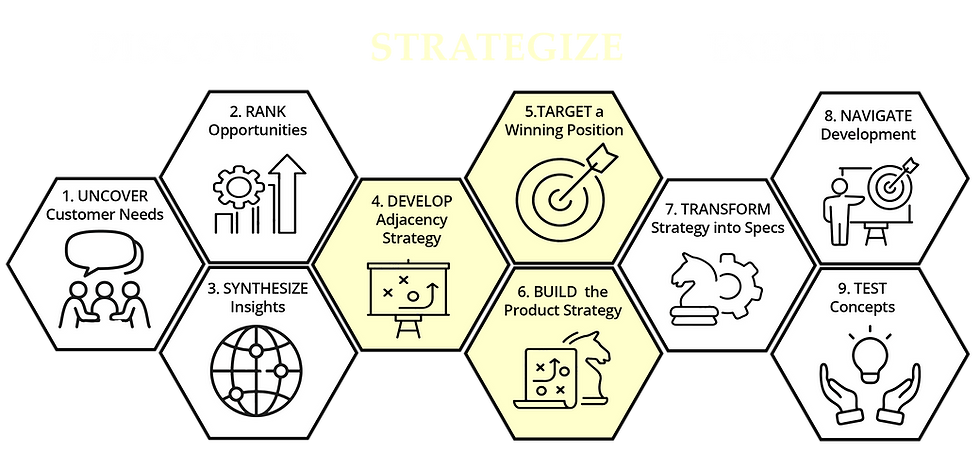
STRATEGIZE
EXECUTE


Find the signal.
Uncover customer needs, rank opportunities, and synthesize insight into a clearer product priorities.
Target where to win.
Use the signal to evaluate adjacent opportunities, define positioning, and build a focused product strategy.
Carry the strategy forward.
Translate strategy into specifications, navigate development tradeoffs, and test concepts before launch.
Nine connected steps for moving from customer evidence to product execution
Each phase contains three practical steps. Together, they help teams move from customer learning to strategic focus to product execution without losing the signal along the way.
Phase I
DISCOVER
1. Uncover Customer Needs
Gather customer input through interviews, observation, existing research, sales feedback, support data, and other evidence sources.
2. Rank Opportunities
Determine which customer needs matter most and where customers are least satisfied today.
3. Synthesize Insights
Use the Signal Translator™ to organize evidence, compare sources, and identify the strongest product signal.
Phase II
STRATEGIZE
4. Develop Adjacency Strategy
Map current and adjacent opportunities to decide where the business should look next.
5. Target a Winning Position
Evaluate competitors, alternatives, and market openings to choose where and how to win.
6. Build the Product Strategy
Turn prioritized opportunities into strategic choices about innovation, differentiation, roadmap focus, and cost tradeoffs.
Phase III
EXECUTE
7. Transform Strategy into Specs
Translate product strategy into clearer specifications, requirements, and development priorities.
8. Navigate Development
Help the strategy survive design, engineering, manufacturability, and commercialization tradeoffs.
9. Test Concepts
Validate concepts with real customers before committing heavily to development or launch.

Built to keep the customer signal visible through strategy and execution
Evidence Before Opinion
Prismatics begins with customer jobs, not internal assumptions about what the market wants. The approach uses the Signal Translator™ to bring together interviews, surveys, sales feedback, support data, competitive insight, and other sources so teams are not over-reliant on a single study or anecdote.
Position Before Investment
Before teams invest heavily in a roadmap, they need to know where they are trying to win. Prismatics helps teams use the customer signal to evaluate adjacent opportunities, understand competitive alternatives, and choose a focused product position with stronger strategic logic.
Strategy Before Specs
Product specifications should come from strategy, not disconnected feature requests. Prismatics helps teams use the chosen product position to decide what to prioritize, where to differentiate, where to reduce cost, and how to translate strategy into requirements, concepts, and development priorities.
Continuity Through Execution
Customer insight often weakens as it moves from strategy into development. Cost, timing, manufacturability, technical constraints, and stakeholder preferences can all pull the work off course. Prismatics helps teams keep the original customer signal visible so tradeoff decisions remain connected to strategy.
Have customer input, but still lack product direction?
If your team is gathering VoC, interview notes, sales feedback, survey data, and customer requests but still struggles to turn it all into product strategy, Prismatics can help clarify the signal and carry it forward into specifications, tradeoffs, and execution.