
HOW TEAMS PLUG INTO THE SYSTEM
How Engagements Work
Most teams do not need to start from zero. They need to understand what customer evidence they already have, what signal can be trusted, and what decisions that signal should guide.
Prismatics engagements usually begin by organizing existing customer insight, building a Signal Translator™, and using that signal to guide strategy, specifications, and execution.
START WITH WHAT YOU ALREADY KNOW
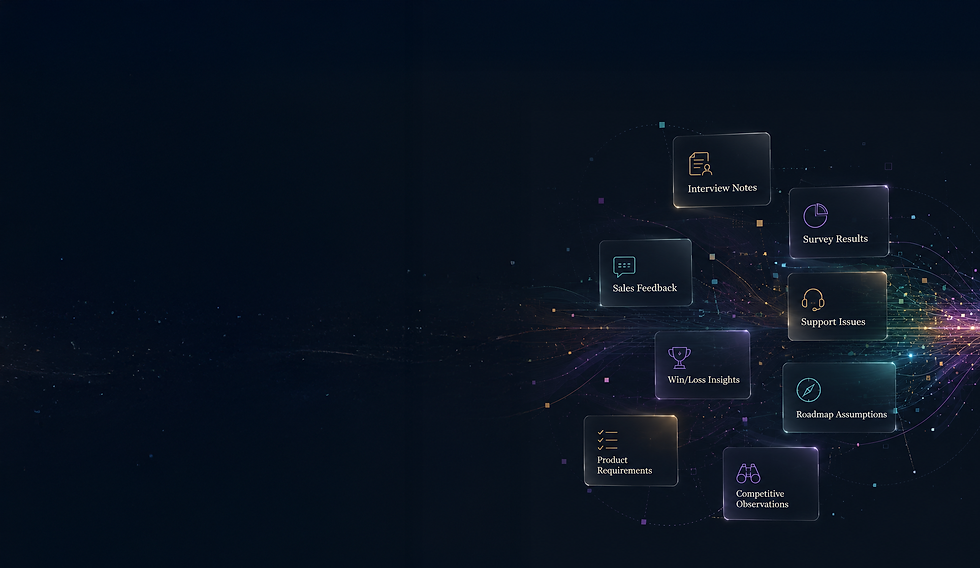
You May Already Have More Customer Insight Than You Think
Most companies already have fragments of customer evidence scattered across the organization: interview notes, survey results, sales feedback, support issues, win/loss insights, product requirements, roadmap debates, and competitive observations.
The problem is not always a lack of information. Often, the problem is that the information has not been organized into a signal strong enough to guide product decisions.
Prismatics usually begins by taking inventory of that evidence, clarifying which markets and customer contexts it applies to, and determining where the signal is strong enough to trust.
A Practical Path Through the Work
HOW THE WORK USUALLY UNFOLDS
01
Audit Existing Customer Insight
Review current research, feedback, assumptions, and market observations to understand what is useful, what is uncertain, and what needs to be clarified.
02
Define the Market Lenses
Clarify which markets, customers, jobs, use cases, and contexts need to be understood separately.
03
Build the Signal Translator™
Organize customer needs, insight, priorities, and strategic implications into a shared working system.
04
Address Insight Gaps
Determine where the signal is strong enough to trust and where additional discovery or VoC may be needed.
The Prismatic Product System™ includes nine steps across DISCOVER, STRATEGIZE, and EXECUTE. But companies rarely enter the work from a blank page. Most already have some mix of customer research, VoC, feedback, requirements, assumptions, and strategic questions.
A typical engagement begins by auditing what the team already knows, building or strengthening the customer signal, and then using that signal to guide strategy, specifications, and product choices.
05
06
07
Develop the Strategy
Translate Strategy Into Specifications
Turn Strategy Into Product Choices
Use the signal to guide adjacency choices, competitive position, innovation focus, cost savings, and roadmap direction.
Convert strategic focus into requirements, measurable criteria, design guidance, and tradeoff decisions.
Support the team as customer signal and strategic focus are translated into the product choices that determine what gets built.




FLEXIBLE ENTRY POINTS
Begin with the decisions in front of you
Most companies do not arrive at the same point.
Some teams have already completed strong VoC work and need help translating it into strategy. Others have scattered customer feedback but no clear view of which needs matter most. Some are trying to enter an adjacent market, sharpen their competitive position, or convert a strategy into specifications the development team can actually use.
A Prismatics engagement begins by locating where the signal is strongest, where it is weakest, and where the next product decision is getting stuck.
The goal is not to force every team through the same sequence. The goal is to begin where the work will create the most clarity.
WHEN MORE INSIGHT IS NEEDED
Build the customer knowledge your strategy depends on

Most teams have more customer insight than they realize. But once that insight is organized, important gaps often become visible.
Some gaps are narrow and decision-specific. Others reveal a larger problem: the team does not yet understand the market, the customer’s job, or the criteria customers use to judge success well enough to guide product strategy with confidence.
When more discovery is needed, Prismatics uses Jobs-to-be-Done to keep the work focused on what customers are trying to accomplish, where they struggle, and how they judge success. That may include additional customer interviews, a sharper Market Lens, refined Job Success Criteria, ranking research, or targeted investigation of a specific market, customer group, or product opportunity.
The goal is not to do more research by default. The goal is to build reusable customer knowledge that improves strategy, strengthens product decisions, and gives teams a clearer view of where to compete and how to win.
TANGIBLE OUTPUTS
Useful outputs, not just recommendations
Prismatics engagements are designed to produce useful working assets, not just recommendations.
Depending on the starting point and scope, the team may come away with a clearer view of existing customer insight, defined Market Lenses, a Job Map, a focused VoC Discussion Guide, a working Signal Translator™, prioritized opportunities, an Adjacent Market Map, product strategy direction, and specification guidance.
The purpose of these outputs is to give the team something it can keep using: a clearer way to understand the market, make product choices, align around customer needs, and preserve strategic intent as the product moves forward.
Specification Guidance
A translation of strategic focus into requirements, measurable criteria, design direction, and tradeoff guidance.
Opportunity Priorities
Describe the service and how your customers or clients can benefit from it. This is the place to add a short description with relevant details, like pricing, duration and how to book.
Job Map
Describe the service and how your customers or clients can benefit from it. This is the place to add a short description with relevant details, like pricing, duration and how to book.
Product Strategy
Guidance on competitive position, innovation focus, cost-saving opportunities, roadmap implications, and where the product should win.
Adjacent Market Map
A strategic view of current and adjacent opportunities, helping the team see where it may have permission, advantage, or room to grow.
Customer Insight Inventory
A structured view of existing customer research, feedback, requirements, assumptions, and market observations.
Signal Translator™
A working system that connects customer needs, insight, priorities, strategic implications, and product decisions.
VoC Discussion Guide
A practical guide for customer conversations, grounded in Jobs-to-be-Done and focused on uncovering needs, struggles, and success criteria.
Market Lens Map
A clearer definition of the markets, customer groups, use cases, jobs, and contexts that should be understood separately.
Build the Signal
Most intensive
Customer insight is organized, gaps are clarified, and the Signal Translator™ begins to turn scattered input into usable direction.
Shape the Strategy
Collaborative
The signal is translated into adjacency choices, competitive position, product strategy, and specification guidance.
Support Product Choices
Advisory
As the product takes shape, Prismatics helps the team keep customer knowledge and strategic intent connected to real tradeoffs.
THE WORKING RELATIONSHIP
Shape the strategy together. Support the choices that follow

Let’s find the right starting point
START THE CONVERSATION
You do not need to know exactly where an engagement should begin. The first step is a conversation about your current customer insight, your product strategy questions, and the work your team is trying to move forward.
Prismatics can help determine whether the next step is organizing what you already know, strengthening customer understanding, building strategy, translating strategy into specifications, or supporting product choices as development progresses.